Expert of Systematic Overall Solution for Calcium Material Resource Utilization


TD75 and DTⅡ type fixed belt conveyors
Product Introduction: Belt conveyors are suitable for conveying various granular, powdery, small-piece materials and piece goods with a loose density of 0.5~2.5t/m³, featuring high conveying capacity and low operating costs.
Applications Widely used in power, metallurgy, chemical industry, coal, mining, building materials, light industry, grain, and transportation sectors.
Product Introduction
Belt conveyors, with their significant advantages, are widely used in many fields. Their strong conveying capacity easily handles the transportation of large quantities of materials. At the same time, their simple structure makes installation, debugging, and maintenance relatively convenient, reducing the cost of use. In addition, belt conveyors are highly versatile and can be customized to meet the conveying needs of various different scenarios.
Highlight Advantages
- Relatively simple structure, easy to maintain, and major components have strong interchangeability and universality.
- Strong conveying capacity, long conveying distance, reliable operation, and easy to achieve automation and centralized control.
- Stable and reliable conveying, with no relative movement between the material and the conveyor belt, which can avoid damage to the conveyed materials.
- Can be customized according to different conveying processes and working environments, with special requirements for heat resistance, cold resistance, water resistance, and corrosion resistance.
Working principle and structure
Belt conveyors mainly consist of a frame, driving device, transmission device, conveyor belt, and tightening device. The roller that drives the conveyor belt is called the driving roller, and the other roller that only changes the direction of movement of the conveyor belt is called the reversing roller. The driving roller is driven by a motor through a reducer, and the conveyor belt is driven by the friction between the driving roller and the conveyor belt. The driving roller is generally installed at the discharge end to increase the traction force and facilitate dragging. Materials are fed from the feed end and fall onto the rotating conveyor belt, relying on the friction of the conveyor belt to transport the materials from the discharge end.
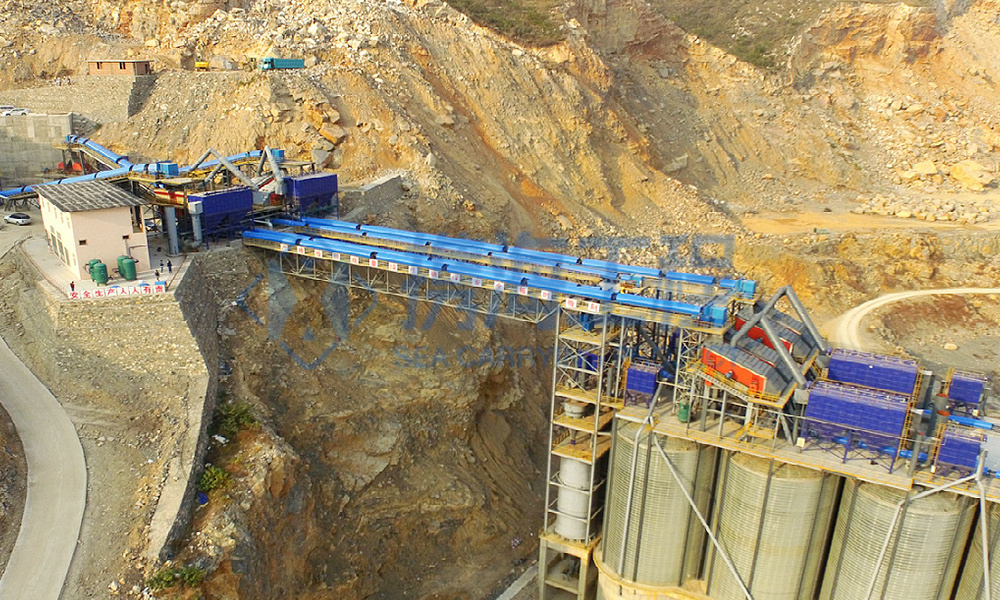
Production site


Technical Parameters
| Cross-Sectional Shape | Belt Speed (m/s) | Belt Width B (mm) | |||||
| 500 | 650 | 800 | 1000 | 1200 | 1400 | ||
| Conveying Capacity Q (t/h) | |||||||
| Trough Shape | 0.8 | 78 | 131 | ||||
| 1.0 | 97 | 164 | 278 | 435 | 655 | 891 | |
| 1.25 | 122 | 206 | 348 | 544 | 819 | 1115 | |
| 1.6 | 156 | 264 | 445 | 696 | 1048 | 1427 | |
| 2.0 | 191 | 323 | 546 | 853 | 1284 | 1748 | |
| 2.5 | 232 | 391 | 661 | 1033 | 1556 | 2118 | |
| 3.15 | 824 | 1233 | 1858 | 2528 | |||
| 4.0 | 2202 | 2996 | |||||
| Flat Shape | 0.8 | 41 | 67 | 118 | |||
| 1.0 | 52 | 88 | 147 | 230 | 345 | 469 | |
| 1.25 | 66 | 110 | 184 | 288 | 432 | 588 | |
| 1.6 | 84 | 142 | 236 | 368 | 553 | 753 | |
| 2.0 | 103 | 174 | 289 | 451 | 677 | 922 | |
| 2.5 | 125 | 211 | 350 | 546 | 821 | 1117 | |
This configuration table is for reference only and may vary depending on customer geographical environment and requirements. Contact Us for details:18031851036。
Free access to more product information
If you are interested in our products, please leave your email, we will contact you as soon as possible, thank you!
Related Cases




Telephone
Company Address
Weier Business 801, No. 92 Huai'an East Road, Yuhua District, Shijiazhuang City, Hebei Province