Expert of Systematic Overall Solution for Calcium Material Resource Utilization


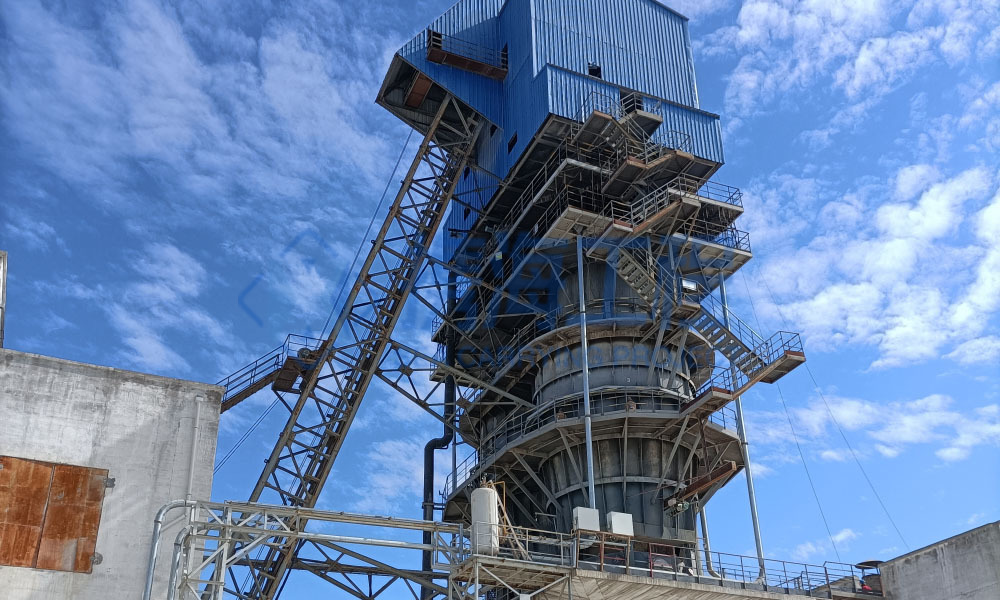
Double-chamber kiln
Introduction:The double-chamber active lime vertical kiln adopts advanced co-current calcination and counter-current heat storage lime calcination principles. In the calcination chamber, the combustion air, fuel, and material all flow downward in the same direction from the upper part of the calcination zone, allowing for gradient combustion of the material, thus avoiding over-burning. In the heat storage chamber, the flue gas and material flow in the opposite direction, enabling sufficient heat exchange between the material and high-temperature flue gas, thereby reducing product energy consumption. Meanwhile, in the cooling zone, the material and cooling air flow in the opposite direction, allowing for rapid cooling of the material, which increases the activity of the lime.
Production Capacity:300 tons to 800 tons/day
Fuel:Natural gas, heavy oil, coal powder, generator gas, acetylene furnace tail gas, lanthanum gas, coke oven gas, converter gas, mixed gas, and mixed fuel of coal powder and gas.


Prominent advantages:
Calcination principle: Co-current calcination, the quality of the roasted product is better, with higher activity, reaching over 360ml, and less residual CO2, generally not exceeding 2.5%; Energy saving aspect: A heat storage and heat exchange system is used, where high-temperature waste gas is discharged through the preheating kiln chamber, and after a longer period of heat exchange, the heat is transferred to the material, making full use of waste heat, thus achieving energy-saving goals. The thermal consumption per unit product can be as low as 850kcal/kg, which is the lowest among various kiln types currently available. Equipment reliability: Most of the equipment on the vertical kiln uses hydraulic operation, ensuring stable and reliable operation. These devices include: air waste gas switching damper, chimney waste gas switching damper, kiln chamber closing damper, feeding hopper damper, discharge device, discharge hopper sealing damper, and material level indicator, etc.
Process Flow:
(1) Raw Material Storage and Transportation
Transport qualified limestone with a particle size of 30-60 or 40-80mm purchased from outside to the storage yard, and load the stone into the receiving hopper set in the yard using a loader. A motorized vibrating feeder is set under the receiving hopper to feed the stone to the feeding belt conveyor, which then sends it to the screening building for screening. The qualified particle size stone after screening enters the pre-kiln storage, and after being weighed by the vibrating feeder and weighing device set under the pre-kiln storage, it is lifted by the feeding cart to the lime kiln for calcination. The undersized powder enters the powder storage and is periodically transported out by a loader. (We can determine the actual screening process based on the specific situation and requirements of the customer).
(2) Limestone Calcination
The double-chamber kiln uses two kiln chambers for calcining lime, where chamber A and chamber B are interconnected at the bottom of the calcination zone, allowing materials to flow down through both kiln chambers. When calcining in chamber A, combustion air and fuel flow with the material in chamber A, allowing the hottest flame to contact the material with a lower temperature that absorbs the most heat. Conversely, the cooler combustion gases contact the material that has been gradually calcined to achieve uniform calcination conditions and obtain high thermal efficiency. The products of combustion and the CO2 released from the material enter chamber B through a connecting passage. At this time, chamber B acts as a heat storage chamber, where the limestone absorbs heat from the exhaust gas while cooling the exhaust gas to a lower temperature, storing heat in the material for use in heating the combustion air in the next cycle. In this scenario, chamber A serves as the combustion chamber, reflecting the co-flow characteristics; chamber B reflects the heat storage characteristics. In the next cycle, they will switch roles, with chamber A becoming the heat storage chamber and chamber B becoming the combustion chamber. This cycle continues, allowing for continuous calcination of limestone.
(3) Ash Discharge and Finished Product Storage and Transportation System
Each unloading ash platform is equipped with 2 hydraulic cylinders, and each unloading ash platform is supported on 4 rollers, with the push-pull drive of the two hydraulic cylinders moving the unloading ash platform back and forth, with a stroke of 150mm. The lime then falls from the edge of the unloading ash platform into the ash discharge hopper. A limit switch is set at the extreme position of the unloading ash platform movement, which should be given special attention. The speed of the ash discharger is adjustable, with both fast and slow options. The unloading ash platforms of kiln chamber 1 and kiln chamber 2 operate independently.
The ash discharge system of the kiln body consists of a reciprocating ash discharger, ash discharge hopper, ash discharge gate, lime collection hopper under the kiln, and vibrating feeder. The calcined lime is pressed on the unloading ash platform and discharged into the ash discharge hopper to cool. The ash discharge gate is hydraulically controlled; when the gate opens, the lime in the ash discharge hopper falls into the lime collection hopper under the kiln and is transported to the ash discharge belt conveyor under the kiln through the vibrating feeder. It is then lifted to the finished product building by a bucket elevator. (We can determine the actual finished product storage and transportation system process based on the specific situation and requirements of the customer).
(4) Flue Gas Treatment
The high-temperature flue gas generated by the combustion in the double-chamber kiln undergoes heat exchange with limestone in the preheater, reducing the temperature to below 150°C before entering the bag filter. After dust removal, the flue gas is discharged into the atmosphere through a high-temperature fan, with a dust concentration of less than 30mg/m3 in the discharged gas. A cold air control system is set at the inlet of the dust collector to protect the dust collector.
Process Flow Diagram

Technical Parameters:
Production Capacity (t/d) |
300 |
400 |
500 |
600 |
700 |
800 |
Main Equipment |
Main Supporting Equipment Models and Technical Economic Indicators |
|||||
Number of Burners (pieces) |
52 |
52 |
66 |
66 |
74 |
74 |
Number of Kiln Chambers (units) |
2 |
2 |
2 |
2 |
2 |
2 |
Number of Ash Discharge Devices (units) |
2 |
2 |
2 |
2 |
2 |
2 |
Calcination Temperature /℃ |
1100±50 |
|||||
Energy Consumption Index / (kCal/kg) |
850⁓900 |
|||||
Electricity Consumption Index / (kW·h/t) |
45±5 |
|||||
Limestone : Lime |
1.7⁓1.78 : 1 |
|||||
Lime Overburning Rate / % |
≤5 |
|||||
Lime Activity / ml |
≥360 (specific to the composition of limestone) |
|||||
Ash Discharge Temperature /℃ |
Ambient Temperature +50 |
|||||
Limestone Granularity Entering Kiln / mm |
30⁓60/40⁓80 |
|||||
Flue Gas Emission Concentration (mg/Nm3) |
≤30 |
|||||
Number of Working Days per Year / days |
>=335 |
|||||
Number of Operators / (people/shifts) |
5⁓8 |
|||||
Applicable Fuels |
Coal Powder, Coke Oven Gas, Lantan Furnace Gas, Converter Gas, Calcium Carbide Furnace Gas, Natural Gas, Diesel, Heavy Oil, Liquefied Petroleum Gas |
|||||
Get more solutions for free
If you are interested in our products, please leave your email, we will contact you as soon as possible, thank you!



Telephone
Company Address
Weier Business 801, No. 92 Huai'an East Road, Yuhua District, Shijiazhuang City, Hebei Province