Expert of Systematic Overall Solution for Calcium Material Resource Utilization


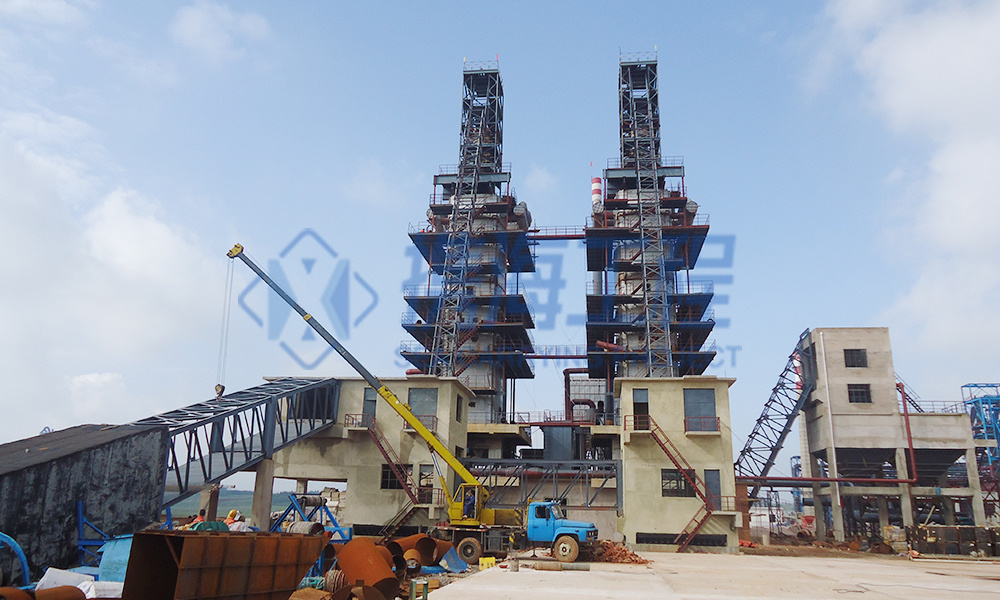
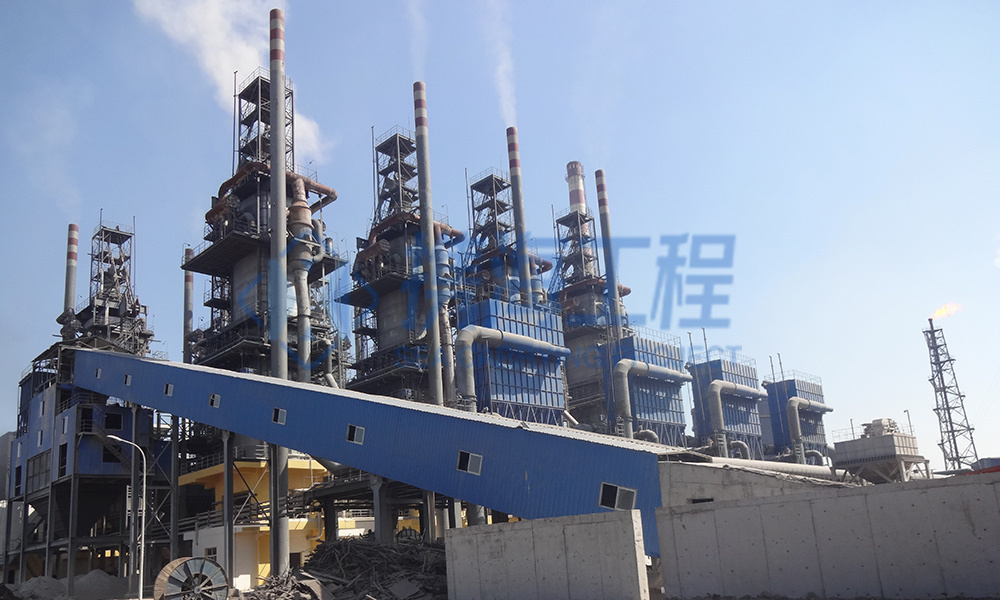
Double Beam Kiln
Introduction:The calcination mechanism of the double-beam kiln is a full reverse flow calcination. Its core part uses a two-layer burner beam, with several fuel pipes supplying fuel to the burners. The burners are distributed on both sides or at the bottom of the beam, ensuring that the fuel is evenly distributed across the cross-section of the kiln, guaranteeing uniform combustion throughout the entire vertical kiln cross-section. The combustion beam is cooled with heat transfer oil, and the heat carried by the heat transfer oil is used to preheat the primary air for combustion, reducing the thermal consumption of the kiln.
The main advantages of the double-beam kiln are the simple shape and construction of refractory materials. The double-beam kiln employs a bidirectional pressure system, with positive pressure below the calcination zone and negative pressure above it. The secondary air required for combustion is blown into the cooling zone by a blower, maintaining positive pressure below the calcination zone inside the kiln; the waste gas from the upper part of the kiln is extracted by an induced draft fan, maintaining negative pressure above the calcination zone inside the kiln.
Production Capacity:100 tons to 500 tons/day
Fuel:Natural gas, heavy oil, coal powder, generator gas, acetylene furnace tail gas, lanthanum gas, coke oven gas, converter gas, blast furnace gas (calorific value ≥ 750 kcal/m3), mixed gas or a mixture of coal powder and gas.

Prominent Advantages:
(1) The kiln operation is highly flexible, adjustable from 50% to 110%, achieving stable production without affecting lime quality and consumption indicators.
(2) Low thermal consumption, reasonable utilization of thermal energy, with secondary air preheating the lime through cooling, and primary air preheated in the preheater before entering the beam burner, ensuring complete combustion of fuel and full utilization of calorific value.
(3) The vertical kiln operates under full negative pressure, ensuring safety and reliability.
(4) The kiln body has no other internal components except for one layer of flue gas extraction pipes, two layers of burner beams, and ash discharge mechanisms, resulting in a simple structure, reduced use of steel and refractory materials, low maintenance requirements, and low operating costs, with comparatively low thermal and electrical consumption.
Process Flow:
(1) Raw Material Storage and Transportation
Transport qualified limestone with a particle size of 30-60 or 40-80mm purchased from outside to the storage yard. Use a loader to load the stone into the receiving hopper set up in the yard. Below the receiving hopper, a motorized vibrating feeder is installed to feed the stone to the feeding belt conveyor, which then sends it to the screening building for screening. After screening, the qualified particle-sized stone enters the pre-kiln storage, where it is weighed by a vibrating feeder and weighing device set below the pre-kiln storage, and then lifted by a feeding cart to the lime kiln for calcination. The undersized powder enters the powder storage and is periodically transported out by a loader. (We can determine the actual screening process based on the specific situation and requirements of the customer.)
(2) Active Lime Calcination System
Materials fall evenly into the kiln, passing through the storage belt, preheating belt, calcination belt, and cooling belt, transforming into finished active lime that enters the ash discharge and transportation process.
A single upper suction beam is set on the storage belt, which spans the kiln cross-section and is equipped with evenly distributed suction ports to ensure that the waste gas in the kiln is evenly discharged outside the kiln, effectively preventing the kiln wall effect.
Two layers of combustion beams are set on the calcination belt, with 12 peripheral burners on both sides of the combustion beam. The combustion beam serves as the main source, while the peripheral burners assist, ensuring that the heat in the calcination area is evenly distributed across the entire kiln cross-section. The temperature of the calcination belt is 1100℃ to 1250℃, where the raw limestone undergoes uniform calcination and transforms into active lime.
A cooling air pipe is set on the cooling belt to cool the finished ash to 80℃ to 100℃.
(3) Heat Transfer Oil System
In the entire system, the heat transfer oil system is a key component of the lime kiln, responsible for cooling the upper and lower beam burners to ensure the normal operation of the equipment.
The main equipment of the heat transfer oil system includes an oil storage tank, electric oil pump, radiator, filter, centrifugal oil pump group, and expansion tank. The medium oil used in the heat transfer oil system is heat transfer oil (model HD320).
Heat transfer oil system workflow: The electric oil pump injects heat transfer oil from the oil storage tank into the circulation system. The circulation oil pump is started, and the heat transfer oil flows through the oil inlet pipe into the upper and lower beam burners, cooling the equipment, and then returns through the return oil pipe to the radiator. After the temperature drops, it enters the filter and then returns to the circulation oil pump.
The heat transfer oil system can be automatically controlled. The system is equipped with thermoresistive thermometers, flow sensors, pressure sensors, and other automatic monitoring devices to ensure the normal operation of the heat transfer oil system.
(4) Finished Product Storage and Transportation System
The finished ash is unloaded through evenly distributed ash discharge hoppers at the bottom of the kiln. Below each ash discharge hopper, there is an electromagnetic vibrating feeder, and below the electromagnetic vibrating feeder, there is a weighing device. This is a interlocking control system that can adjust the ash discharge amount at each discharge port to ensure uniform ash discharge across the entire kiln cross-section, preventing skewing of the kiln. The ash coming out of the weighing device directly enters the storage hopper (which can store an amount for 1 hour). The material in the storage hopper is transported to the lime finished product warehouse via a motorized vibrating feeder, kiln belt conveyor, and bucket elevator. The lime in the warehouse is unloaded to trucks through the unloading valve at the bottom of the warehouse and transported periodically by trucks. (We can determine the actual finished product storage and transportation system process based on the specific situation and requirements of the customer.)
(5) Flue Gas Treatment System
The high-temperature flue gas generated by the double beam kiln undergoes heat exchange with combustion air in the preheater, reducing the temperature to below 200℃, and then enters a bag filter. After dust removal, it is discharged into the atmosphere through a high-temperature fan, with a dust concentration of less than 30mg/m3 in the discharged gas. A cold air control system is set at the inlet of the dust collector to protect the dust collector.
Process Flow Diagram

Technical Parameters:
Production Capacity (t/d) |
100 |
150 |
200 |
300 |
400 |
500 |
Main Equipment |
Main Supporting Equipment Models and Technical Economic Indicators |
|||||
Number of Combustion Beams (pieces) |
4 |
5 |
5 |
7 |
9 |
11 |
Number of Suction Beams (pieces) |
2 |
3 |
3 |
3 |
4 |
4 |
Number of Ash Discharge Devices (units) |
2 |
4 |
4 |
6 |
8 |
8 |
Calcination Temperature /℃ |
1100±50 |
|||||
Energy Consumption Index / (kCal/kg) |
1150±100 |
|||||
Electricity Consumption Index / (kW·h/t) |
35±5 |
|||||
Limestone : Lime |
1.7⁓1.78 : 1 |
|||||
Lime Overburning Rate / % |
≤10 |
|||||
Lime Activity / ml |
>=320 (specific to be determined by the composition of limestone) |
|||||
Ash Discharge Temperature /℃ |
Ambient Temperature +50 |
|||||
Limestone Granularity Entering Kiln / mm |
30⁓60/40⁓80 |
|||||
Flue Gas Emission Concentration (mg/Nm3) |
≤30 |
|||||
Number of Working Days per Year / Days |
>=335 |
|||||
Number of Operators / (people/shift) |
5⁓8 |
|||||
Applicable Fuels |
Coal Powder, Coke Oven Gas, Lantan Furnace Gas, Converter Gas, Blast Furnace Gas, Calcium Carbide Furnace Gas, Natural Gas, Diesel, Heavy Oil, Liquefied Petroleum Gas |
|||||
Get more solutions for free
If you are interested in our products, please leave your email, we will contact you as soon as possible, thank you!



Telephone
Company Address
Weier Business 801, No. 92 Huai'an East Road, Yuhua District, Shijiazhuang City, Hebei Province